
When parking gets tight, the instinct is simple: build more. More spaces, less complaining, problem solved.
Except it’s rarely that simple. Building new parking is expensive, slow, and often at odds with your sustainability targets. Before you approve a construction budget, it’s worth doing the maths on the alternative: managing the parking you already have, better.
We ran the numbers for a company of 1,000 employees. Here’s what we found.
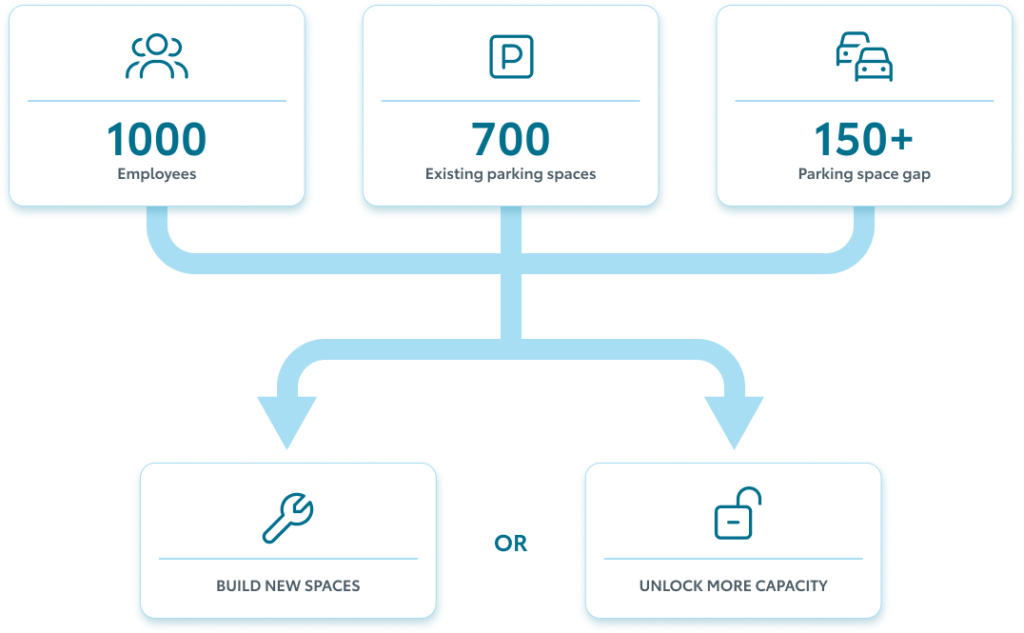
Let’s say your company has 1,000 employees and around 700 existing parking spaces. Demand has grown, and you need roughly 150 more spaces to keep people happy.
You have two broad paths: build new spaces, or unlock more capacity from the ones you already have.
Construction costs vary by type and location, but published industry figures give a reasonable planning range:
For 150 spaces, that works out to roughly:
Then there’s the time.
And for however long that build takes, it’s happening right on your doorstep. Contractors typically fence off the work area and the spaces around it for deliveries, machinery, and site access, so you can expect to lose some of your current parking capacity for the weeks or months it takes to finish, on top of the noise, dust, and disrupted access that come with any construction site. That’s added pressure at exactly the time parking is already tight.
And all of this is before ongoing maintenance, resurfacing, insurance, and business rates, which add to the bill every single year. It’s also before you factor in planning permission, which isn’t guaranteed, and the loss of green space, which rarely helps your ESG reporting.
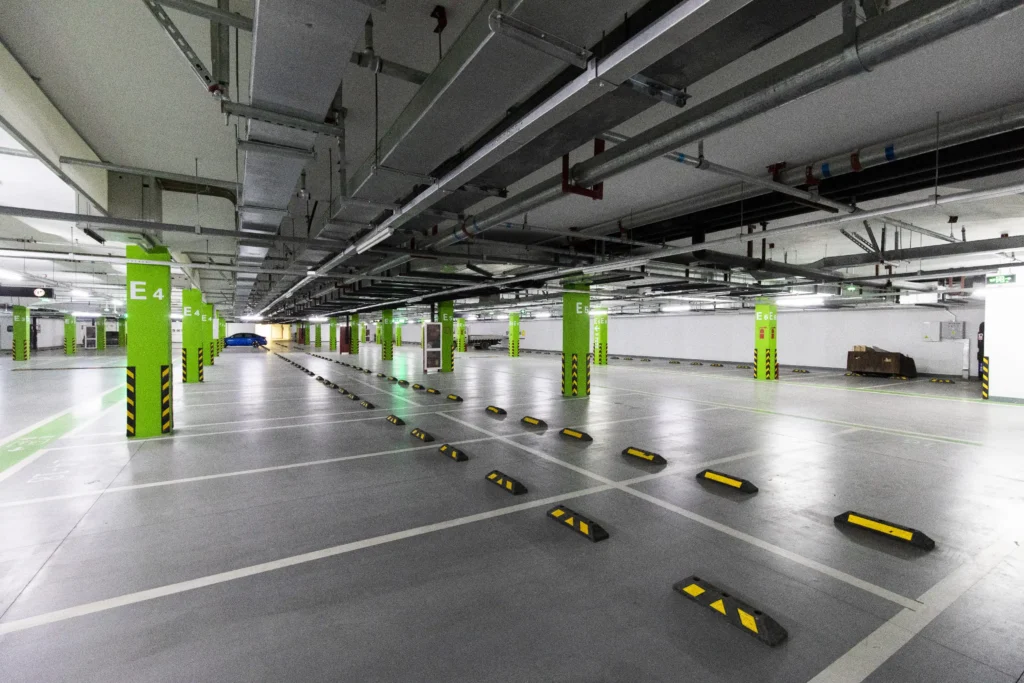
The alternative is improving how your existing 700 spaces are used. Dynamic allocation, real-time occupancy tracking, and space sharing can lift effective parking capacity by 20 to 40%, according to industry benchmarks. On 700 spaces, that’s 140 to 280 additional spaces worth of capacity, without pouring a single square metre of concrete.
The cost of getting there is a fraction of construction, though it depends on the setup:
An ongoing software subscription usually runs to roughly £14,000 to £29,000 a year on top of that.
Put together, that’s a first-year investment of somewhere between £34,000 and £269,000, covering the same 150-space gap that construction would.
The timeline looks very different too.
While a new car park is still waiting on planning permission, a smart parking system can already be live and freeing up space.

Compared with a surface car park, smart parking management typically costs 25 to 75% less.
Compared with a multi-storey structure, it typically costs 80 to 95% less.
Even at the most expensive end of the smart parking range, you’re still spending less than the cheapest construction option. That’s a hard number to argue with in a budget meeting
There’s a quieter cost too: the hours that go into manually managing parking. Spreadsheets, email chains about who gets which space, and manually updating who’s assigned where every time someone joins, leaves, or changes teams. It adds up to real hours every week for whoever’s stuck with the job, usually facilities or an office manager.
It’s not just an admin problem either. Employees who circle the car park looking for a space, or arrive frazzled after a parking battle, don’t walk into the building in the best frame of mind. The average driver loses around 17 hours a year just searching for parking, nearly two full working days, and that stress has a habit of following people to their desk. A well-managed car park isn’t only about efficiency. It’s one less thing chipping away at how people feel at the start of their day.
And this cuts both ways. Building new parking works against most sustainability commitments: more concrete, less green space, and a clear signal that the default response to demand is still “more cars.” Smart parking management moves in the opposite direction. Because everything runs through one system, you get visibility you simply can’t get from a spreadsheet: who’s parking, how often, and how that connects to your wider commuting picture.
This is where KINTO Join goes a step further than a standard parking tool. Alongside managing space allocation, it tracks the CO2 impact of how your organisation commutes, and it’s built to actively encourage carpooling, EV use, and other lower-emission choices, not just accommodate them. For a facilities or sustainability manager, that means the same system solving your parking pressure today can also feed directly into your ESG reporting, without a separate project to make that happen.
There is no single parking policy that will work for every organisation. The right approach will depend on factors such as the size of your workforce, the available space, commuting patterns and the way your workplace operates.
For some organisations, the first step may simply be to understand demand more clearly. For others, the priority may be reviewing allocation policies, preparing for increased EV adoption or reducing the amount of manual administration involved.
The important thing is to start with a clear understanding of the challenges you are actually trying to solve. From there, even relatively small changes can help make workplace parking easier to manage, fairer for employees and better aligned with wider workplace and sustainability goals.
If you would like to explore the topic in more detail, our Smart Parking Playbook looks at practical ways organisations can reduce parking pressure and make better use of their existing capacity.