
Many organisations assume that parking shortages can only be solved by creating more spaces. In reality, expanding a car park is often the most expensive option, and not always the most effective.
In our previous article, we explored how better parking utilisation can unlock 20–40% more effective capacity from the spaces you already have. But making better use of existing spaces is only half the equation.
The other approach is to reduce parking demand itself by giving employees better reasons to leave the car at home or share the journey. Small changes, such as rewarding carpooling or spreading office attendance more evenly across the week, can significantly reduce the number of cars arriving on site without restricting employee choice.
There’s no single solution that works for every workplace, but these are the approaches that consistently deliver the biggest impact.
Rather than expanding parking, some organisations look at how their parking policy can support other ways of commuting. Carpooling tends to be the most immediate opportunity, especially when it’s rewarded with something simple and visible.
The examples below are drawn from organisations we’ve worked with and illustrate how different approaches can reduce parking demand without adding more parking spaces.
One large financial services organisation wanted to ease pressure on its car parks without expanding them. It introduced guaranteed parking for employees who shared their commute. Within eight months:
The initiative saved more than 23,000 km of travel and reduced CO₂ emissions by around 2,700 kg, all without creating a single additional parking space.
A smaller hybrid technology company faced a very different challenge. Parking availability wasn’t an issue, but encouraging employees to try alternatives to driving was. A modest reward, such as a pair of wireless earbuds, was enough to encourage people to give it a try.
Once the habit formed, it stuck: 78% of employees signed up, and no participants dropped out over the following 18 months. If simple incentives can achieve these results where parking isn’t a problem, they can be even more effective where demand regularly exceeds supply.
None of these organisations added a single parking space. The results came from encouraging a different choice, not from expanding supply.
It might be worth considering whether your current parking policy makes driving alone the easiest option by default
For organisations with hybrid or staggered working patterns, it’s often worth looking at when people come in, not just how many.
If most employees are expected on-site the same two or three days, that’s usually when demand peaks hardest. Coordinating attendance across teams, often in conversation with HR, can spread that demand more evenly across the week. Fewer cars arrive on any single day, even if total attendance stays the same.
It could be worth comparing the busiest parking days with office attendance patterns, to see whether demand is naturally spread out or concentrated on the same day
None of the above needs to start as guesswork. A short survey can reveal who might realistically switch to carpooling, cycling, or public transport, and where the appetite already exists.
KINTO Join’s free Commuting Survey is designed for exactly this. It gives organisations a clear picture of how people currently get to work, so it’s easier to see which incentives would make the most difference.
Try KINTO Join’s FREE Commuting Survey >>
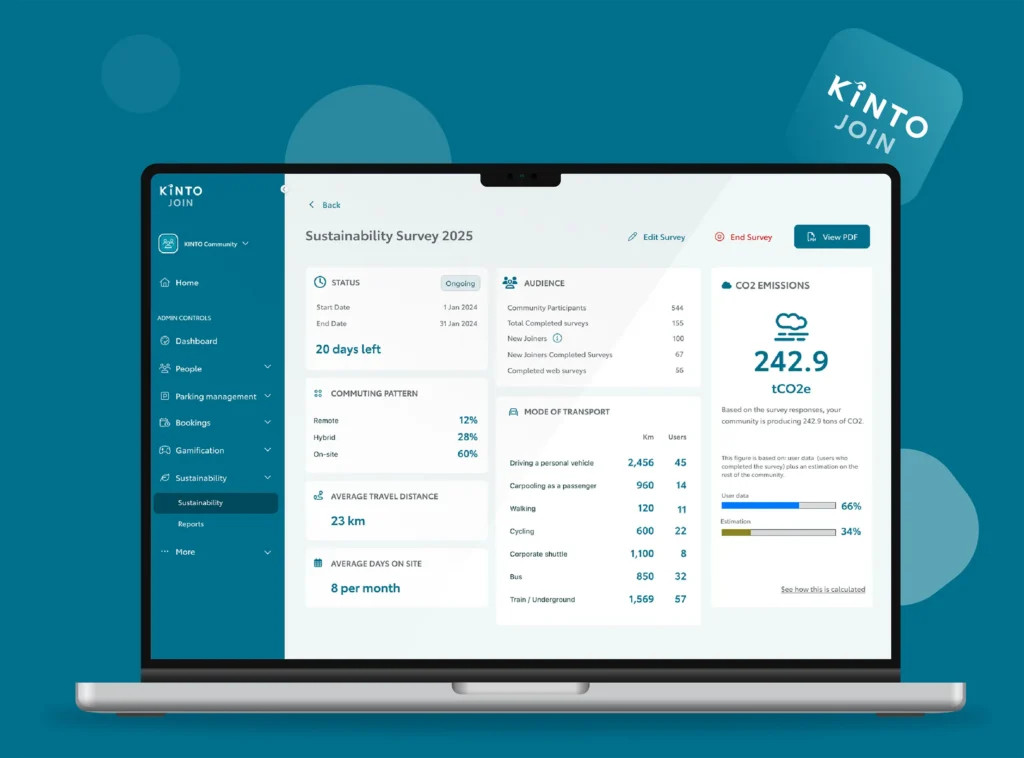
Rewarding carpooling and coordinating schedules can go a long way with simple tools. As those efforts grow, so does the coordination behind them, tracking who’s participating, verifying journeys, and keeping incentives fair.
This is usually the point where organisations look at a dedicated platform. KINTO Join handles carpool matching, verified trip tracking, and reward campaigns in one place, while also tracking the CO₂ impact of those journeys for ESG reporting.
There’s no single formula that works everywhere. The right mix depends on the workforce, the site, and how people already get to work.
For organisations curious about how this would work for their own car park, we’re happy to walk through it together.
Explore how KINTO Join can help you reduce demand and maximise existing capacity